A comprehensive suite of modules designed to optimize every aspect of your utility network operations.
The transition toward a sustainable energy landscape necessitates a fundamental reconfiguration of how utility networks are managed, monitored, and optimized. The traditional Supervisory Control and Data Acquisition (SCADA) and Energy Management Systems (EMS) that have governed utility operations for decades are increasingly viewed as legacy bottlenecks. These systems, while effective for real-time deterministic control, lack the analytical depth, historical data retention, and cross-domain intelligence required to navigate the complexities of modern deregulated markets and high-penetration renewable grids. The YDURA™® Networks Management Application (NMA) emerges as a transformative intervention, designed to bridge the structural gaps between real-time operational technology (OT) and strategic business intelligence.
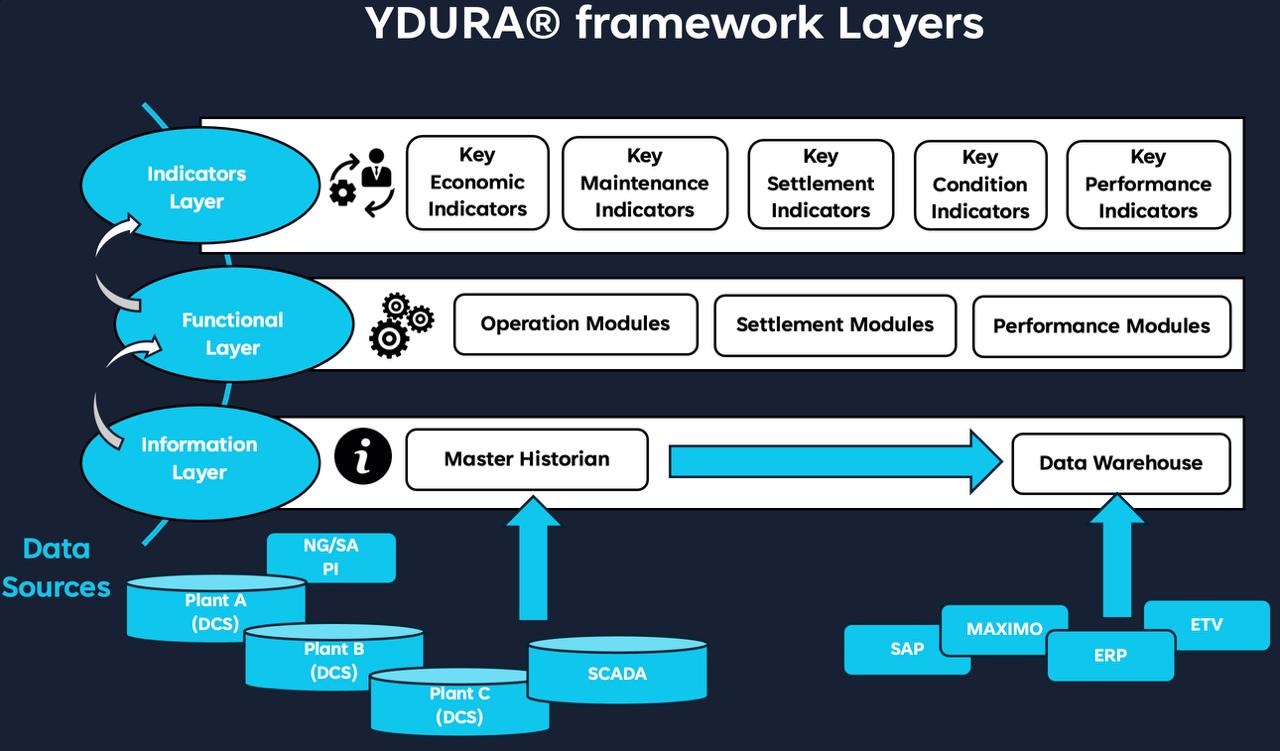
YDURA framework's utility interface, specifically addressing the requirements of the Electric, Water, Oil, Gas, Telecom, and emerging Smart Infrastructure sectors. By integrating the rigorous technical arguments and Artificial Intelligence (AI) optimization focuses defined in the YDURA V3 technical specifications, the framework moves beyond the static representations found in previous iterations of the system's digital assets. This refactoring is grounded in a three-layer architectural model—Information, Functional, and Indicator—that ensures every physical parameter, from voltage sags to pipeline corrosion, is captured and processed through a cognitive closed-loop system.

The YDURA framework is structured to overcome the "data silo" problem characteristic of large business management. Traditional utility architectures are often discrete, with operators, dispatchers, and planners working across disconnected applications and unstructured data formats such as memos and spreadsheets. YDURA proposes a unified structure that transforms raw telemetry into executive-level decision-making tools through three distinct but interconnected layers.
The Information Layer serves as the enterprise's Master Historian and Data Warehouse. In legacy environments, SCADA data is often retained for only 24 hours, severely limiting the capacity for longitudinal analysis or predictive modeling. It captures real-time streams from SCADA/EMS and transforms them into long-term assets for trend identification and strategic forensic analysis. YDURA™® creates a centralized repository that integrates data from Distributed Control Systems (DCS), Smart Meters, IoT devices, and external Application Programming Interfaces (APIs) such as meteorological services.
The mechanism of this layer involves a sophisticated Extract, Transform, and Load (ETL) or Extract, Load, and Transform (ELT) process. Raw operational data is cleaned to handle missing sensor values, mapped to standardized asset identifiers, and aggregated to provide the granularity required for long-term trend analysis. This layer also integrates with Enterprise Resource Planning (ERP) systems like SAP and Asset Management platforms such as IBM Maximo, ensuring that operational telemetry is contextualized within the broader business framework.
The Functional Layer contains the specialized application modules that handle the daily activities of the control center. These modules include the Dispatcher Logbook, Scheduling, Load Forecasting, and Unit Commitment. A unique feature of the YDURA framework is the introduction of "Operational Middleware". This middleware sits between the raw SCADA telemetry and the higher-level indicator layer, passing data through an AI filter to detect anomalies and identify potential failures before they occur.
For example, the Dispatcher Logbook module digitizes control room activities, capturing structured logs for every incident, trip, and switching operation. This replaces manual, handwritten logs that are prone to error and difficult to audit. Similarly, the Scheduling Module optimizes maintenance planning by simulating the impact of planned outages on network stability, checking for $N-1$ security violations in real-time.
The top tier of the architecture is the Indicator Layer, which provides the executive team with high-level Key Management Indicators (KMIs) and Key Performance Indicators (KPIs). These indicators are designed to be Specific, Measurable, Action-oriented, Realistic, and Time-bound (SMART). The framework utilizes a Balanced Scorecard approach to translate operational performance into strategic outcomes across four core objectives: Reliability, Sustainability, Economy, and Quality.
The Indicator Layer is composed of five specialized management modules:
YDURA™® provides real-time insights that enable better decision-making, which results in more efficient operations, reduced costs, and improved service quality for customers. By facilitating a seamless flow of information, YDURA™® empowers utility staff to address challenges proactively, ensuring the sustainability and reliability of essential services. This comprehensive approach not only enhances operational performance but also aligns with broader organizational goals, such as sustainability and customer satisfaction.